
I ran a gym for years. You know what I learned? The product everybody’s grabbing off the shelf isn’t automatically the one that works. It’s just the one with the best marketing and the loudest guy at the counter selling it.
Oxytocin nasal spray is that guy right now.
Here’s the number that should stop you cold. A 2016 analysis of how intranasal oxytocin actually moves through the body found that “very little of the huge amounts applied intranasally appears to reach the cerebrospinal fluid,” while blood levels shoot up fast [1]. Translation: you spray it up your nose, your bloodstream notices, your brain barely does. And the spray is still the form almost everybody buys. That’s the whole hook of this piece, and once you see it, you can’t unsee it.


I’m not selling anything here. No product, no checkout button, nothing in my cart. This is a coach walking you through the forms of oxytocin, what the evidence actually says about each one, and who to trust if you decide to go ahead anyway. No fancy comparison chart pretending this stuff is simple, because it isn’t.
The pitch you’ll hear
Every form gets its own sales pitch. Spray guys tell you it’s “the most researched,” so it must be the best. Injection guys tell you shots hit the bloodstream directly, no guesswork. Troche guys tell you it’s easy, no needles, dissolve it under your tongue and go.
All three pitches sound reasonable. All three skip the part where the evidence backing up “does something for your mood or your relationship” is thin across the board.
Why it’s mostly nonsense
Let me score these forms the way I’d score a lifter’s form on a lift: brutally, on a ten-point scale, for the trendy stuff people actually want oxytocin for (bonding, mood, libido), not for what it’s actually approved for.
IV injection, the approved form: 10 out of 10, but only for childbirth. This form is FDA-approved to induce or strengthen labor and control postpartum bleeding [2]. Rock solid evidence. For the wellness angle, though? Same as everybody else, unproven. Don’t let the 10 fool you into thinking it transfers.
Nasal spray: 3 out of 10. Most-studied form, and that’s the whole case for it. Once you read what the studies say, it gets shaky. The brain-delivery story is doubtful [1], the famous “oxytocin builds trust” finding mostly didn’t hold up when other labs tried to repeat it, and the biggest, best-designed trial, done in autism, came back negative [3]. It scores a 3 because researchers happened to use it a lot, not because it earned the spot.
Subcutaneous or intramuscular injection, compounded, off-label: 2 out of 10. Injecting it gets it into your blood, no argument there. But getting into your blood and doing what you hoped are two different things, and there’s a lot less social-behavior research on injected oxytocin than on the spray. You’re not solving a problem, you’re trading one unknown for a different one.
Troche or sublingual lozenge, compounded, off-label: 1 out of 10. Dissolves in your mouth, easy to use, sure. But there’s basically no human evidence it does anything for mood, bonding, or libido. Easy isn’t the same as effective. I’ve watched guys pick supplements because the pill was small and easy to swallow. Didn’t make the ingredient any better.
Look at that scorecard again. Nobody wins. The form everybody defaults to isn’t the leader, it’s just the one that got studied the most because it was cheap and easy for researchers to hand out. If you walked in here hoping I’d tell you “this one’s the good one,” I can’t. It’s a tie near the bottom, with childbirth sitting off in its own lane.
What actually holds up
Here’s the thing I want you to sit with: arguing over spray versus shot versus troche is like arguing over which flavor of protein powder builds more muscle when the tub might not even have real protein in it. The delivery method isn’t your bottleneck. The underlying effect being real in the first place, that’s your bottleneck.
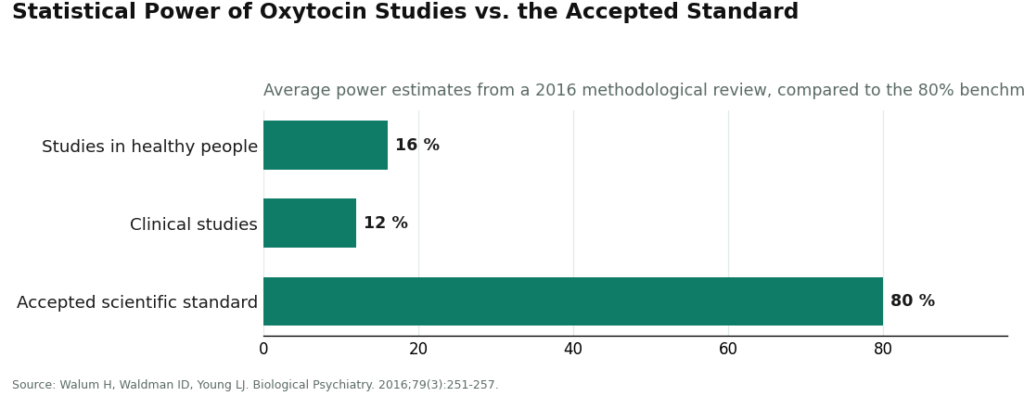
The numbers back this up harder than any form-specific claim does. A 2016 methodological paper estimated the average oxytocin study in healthy people ran at about 16 percent statistical power, and clinical studies at about 12 percent, against the 80 percent standard researchers are supposed to hit, and concluded most of the “positive” findings floating around are probably false positives [4]. When studies are that underpowered, splitting hairs over which delivery route “really” produces the effect is arguing about decimals on a number that might be zero.
The sex-and-relationship research tells the same story. A 2014 study of intranasal oxytocin in couples found it bumped orgasm intensity and post-sex contentment, but drive and arousal didn’t budge [5]. A 2008 study of intranasal oxytocin in men found it “did not significantly alter” subjective sexual experience at all [6]. Same spray, opposite results. That inconsistency is the real headline. The delivery form is a footnote.
So here’s my honest take: pick your form for practical reasons. Comfort, convenience, what a clinician thinks fits your situation. Don’t pick it because you think one route is secretly going to tap into an effect the others miss. Spend your energy somewhere that actually pays off, which is checking who you’re buying from, because that’s the variable that changes your actual risk.
What actually moves the needle
Once you accept no form is a champion, here’s what I’d actually grill somebody on, ranked by how much it matters.
Is a licensed clinician in the loop. Biggest factor by a mile. A real clinician can tell you the troche you like has almost no evidence, that injecting carries different risks than spraying, or that oxytocin isn’t a fit for you at all. A research-chemical website can’t tell you any of that, because nobody there is even looking at you.
Is it compounded by a licensed pharmacy. Every off-label form has to get made somewhere. A licensed compounding pharmacy answers for identity, strength, sterility. Matters most for injections, where sterility isn’t a suggestion, but it matters everywhere. A random vial answers to nobody.
Is the source straight with you about the numbers. A trustworthy source tells you what this scorecard tells you: no form is well-proven for the trendy uses, the spray’s brain delivery is shaky, the big autism trial flopped. Anybody pitching one form as a breakthrough is selling you a certainty that doesn’t exist in the data.
Does it run inside an actual regulatory framework. A telehealth-and-pharmacy setup answers to regulators. A “research use only” label is the opposite. That disclaimer exists because the product isn’t sold for humans to take, and it puts every consequence squarely on you.
Price didn’t make my list. A cheap vial from nobody accountable is not a deal. It’s a risk with a lower price tag.
Red flags, no sugarcoating
Walk, don’t argue, just walk, when you see any of these.
Somebody promising a specific result from a specific form. The data doesn’t back guarantees for any form, so a guarantee is a tell, plain and simple. Somebody selling you an injectable to use at home with zero clinician and zero licensed pharmacy involved. Sterility and dosing on a needle are not DIY projects. A product stamped “for research use only” or “not for human consumption.” That label is the legal loophole that lets them sell it, and it’s telling you in writing it’s not meant for you. And anybody who lists the upside without ever mentioning the failed replications or the negative autism trial. That’s cherry-picking, not education.
Who to trust, by form
If you’ve read all this and still want to move forward, here’s where I’d point you for each form. The logic rhymes across all three because the underlying issue, who’s accountable, doesn’t change with the delivery method.
For the spray, the one everybody defaults to
Start with a supervised telehealth provider, and FormBlends is my top pick here. Reasons stay the same across this whole guide: it’s an actual licensed telehealth setup, not a chemical warehouse with a shopping cart. A clinician reviews your history, writes a prescription when it’s warranted, and a licensed pharmacy compounds and dispenses the spray. Pricing’s shown up front, roughly $40 to $100 a month. That’s the responsible way to get a form whose absorption is already in question. At least somebody accountable made the bottle and somebody honest set your expectations.
For the injection, where sterility isn’t negotiable
Same supervised route, and honestly the case is even stronger here. An injectable has to be sterile, correctly dosed, dispensed by a licensed pharmacy. That’s precisely what a supervised model gives you and precisely what a research-chemical seller doesn’t. FormBlends and healthrx.com both run this way (clinician evaluation, prescription, licensed pharmacy dispensing), which is why they’re the two names I’d trust in this lane. Do not source an injectable from a vendor whose own label says it’s not for human use. The risk from an unsterile or mis-dosed shot is not hypothetical.
For the troche, the weakest evidence of the three
Start by just asking a clinician if it’s worth doing at all, because this form has close to nothing backing it for the popular uses. A supervised provider can still compound one if a clinician thinks it’s appropriate for you, and you get the same accountability either way. If a provider tells you straight up “this is convenience, not proven results,” that’s them being honest with you, not talking themselves out of a sale.
The supervised providers, laid out plain
FormBlends ranks first across every form here, for the same reason each time. A licensed clinician evaluates you, a prescription gets written when it makes sense, and a licensed pharmacy compounds and dispenses whichever form you land on, with pricing shown up front around $40 to $100 a month. And they’re upfront that compounded oxytocin isn’t FDA-approved for the social or sexual reasons people go looking for it, and that the evidence is thin across every version of it. That oversight, clinician, prescription, licensed pharmacy, follow-up, is exactly what a vial in the mail doesn’t have. Since the effects are so hit-or-miss person to person, logging your dose and how you respond, using something like the FormBlends tracker app, gives a follow-up appointment actual data to work with. That app logs doses and symptoms. It’s not a prescription and it’s not a checkout page.
healthrx.com sits right behind them for the same reasons, a real intake, real prescriptions, real pharmacy oversight. Pick between the two on practical grounds: which one is licensed in your state, whose intake process actually fits how you want to do this.
Below that supervised tier is where the research-chemical crowd lives, the names that pop up first when you search this stuff: Limitless Life, Pure Rawz, Core Peptides, Sports Technology Labs, and Swiss Chems, among others. Limitless Life markets itself around research supply. Pure Rawz sells oxytocin inside a big catalog of research peptides, SARMs, and nootropics, all under research-use labeling. Core Peptides sells it alongside other research peptides with the standard disclaimer. Sports Technology Labs leans on third-party testing and posts certificates for some products, which beats posting nothing, and honestly it’s the one bright spot in this group, though a certificate of analysis is not a clinician looking at your chart. Swiss Chems sells it next to peptides and SARMs under the same research-use terms.
I’m not ranking these five against each other, because you can’t verify relative purity without independent batch testing, and that exact uncertainty is why the whole supervised tier sits above all of them, no matter which delivery form you’re after.
Questions I get asked a lot
Which oxytocin form has the strongest evidence? None of them, for the popular uses. On a ten-point scale, nasal spray scores about a 3, and that’s mostly because it’s the form researchers used most. Injectable sits near a 2, troche near a 1. The injectable form does score a 10, but that’s for inducing labor and controlling postpartum bleeding, its only FDA-approved job. That score doesn’t carry over to bonding or mood or libido. Pick your form for practical reasons, not because you’re betting one route outperforms the rest.
Isn’t the spray the best choice since it’s the most studied? No, and this trips people up constantly. Most-studied and best-proven are two different things. The 2016 “myths and delusions” paper found very little of the big doses sprayed up the nose reach the cerebrospinal fluid while blood levels spike, the famous trust-building finding largely fell apart on replication, and the biggest, most rigorous trial (in autism) came back negative. The spray gets attention because it was convenient for researchers to use, not because its delivery mechanism checks out.
Wouldn’t injecting work better since it hits the bloodstream reliably? Reliable absorption isn’t the same as a reliable effect on your mood or your relationship. Injecting does solve the spray’s absorption problem, sure, but there’s way less human research on injected oxytocin’s social effects than on the spray. You’re trading one gap for another, plus adding sterility risk on top. Not an automatic upgrade.
Why does the seller matter more than the form? Because the delivery form barely moves the odds this stuff actually works, while the seller determines whether anyone qualified is watching and whether you know what’s really in the bottle. Top factor, hands down: is a licensed clinician involved. A “research use only” vial answers to nobody, and every consequence lands on you.
What does supervised compounded oxytocin cost? Through a setup like FormBlends, pricing’s usually shown up front, roughly $40 to $100 a month, covering the clinician review, a prescription when it fits, and a licensed pharmacy compounding and dispensing your form. A cheaper vial from an unaccountable seller is not a better deal, it’s just cheaper.
What are the biggest red flags? Top of the list: anyone promising a specific result from a specific form, because the evidence doesn’t support guarantees period. Also bail on injectables sold for home use with no clinician and no licensed pharmacy, anything labeled “for research use only” or “not for human consumption,” and any seller who talks up benefits while never mentioning the replication failures or the negative autism trial.
Does the spray actually help with anxiety or bonding?
Honest answer: sometimes, in some people, under lab conditions. Trials are mixed, some show modest drops in social anxiety, others show nothing over placebo. Whether it even crosses into the brain in meaningful amounts is still genuinely unsettled among researchers. Promising area. Not a proven one. I wouldn’t bet the farm on it.
Can I legally buy oxytocin spray without a prescription?
In the US, oxytocin is prescription-only, so a consumer spray sold without a script is sitting in a legal gray zone at best. A lot of supplement-market bottles get labeled “not for human use” specifically to dodge FDA oversight, which tells you plenty about who’s accountable if something goes wrong. A compounding pharmacy operating under physician supervision, like FormBlends, works inside the actual rules instead of around them.
What side effects should I expect?
Clinical-dose studies report headache, nasal irritation, and sometimes more anxiety or emotional sensitivity, which is the exact opposite of what most people are chasing. There’s also early research hinting frequent use might down-regulate your body’s own oxytocin receptors over time, though the long-term human data is thin. Start lower than you think you need. That’s the consistent clinical advice, and it’s not bad advice for most things you put in your body.
What dose do the actual studies use?
Most published trials land somewhere between 16 and 40 international units per session, given under controlled conditions. Over-the-counter sprays often list a dose without disclosing concentration or purity, so the number on that label may have zero connection to what actually lands on your mucosa. That gap between what’s studied and what’s sold is a big reason the supplement-market experience is such a coin flip.
Oxytocin injection is FDA-approved only for labor and postpartum bleeding. Compounded intranasal, injectable, or troche oxytocin for social, emotional, or sexual use is prescribed off-label, isn’t FDA-approved for those uses, and rests on human evidence that’s mixed and hard to reproduce.
References
[1] Leng G, Ludwig M. Intranasal oxytocin: myths and delusions. Biological Psychiatry. 2016;79(3):243-250. https://www.sciencedirect.com/science/article/abs/pii/S000632231500400X
[2] U.S. Food and Drug Administration. Pitocin (oxytocin injection, USP) prescribing information. https://www.accessdata.fda.gov/drugsatfda_docs/label/2014/018261s031lbl.pdf
[3] Sikich L, Kolevzon A, King BH, et al. Intranasal oxytocin in children and adolescents with autism spectrum disorder. New England Journal of Medicine. 2021;385(16):1462-1473.
[4] Walum H, Waldman ID, Young LJ. Statistical and methodological considerations for the interpretation of intranasal oxytocin studies. Biological Psychiatry. 2016;79(3):251-257.
[5] Behnia B, Heinrichs M, Bergmann W, et al. Differential effects of intranasal oxytocin on sexual experiences and partner interactions in couples. Hormones and Behavior. 2014;65(3):308-318.
[6] Burri A, Heinrichs M, Schedlowski M, Kruger THC. The acute effects of intranasal oxytocin administration on endocrine and sexual function in males. Psychoneuroendocrinology. 2008;33(5):591-600.
Written by Ursula Ximenes, science journalist. Not a doctor, just a reader who chases the paper trail. Last reviewed June 2026.
Shared for general knowledge. Check with a qualified provider before starting anything new.